"Gut Health" Has Become a Dining-Table Standard — The Fermented Food Boom in Autumn 2026
機械翻訳 / Machine-translated

白石美月
2026年9月4日・11分で読める
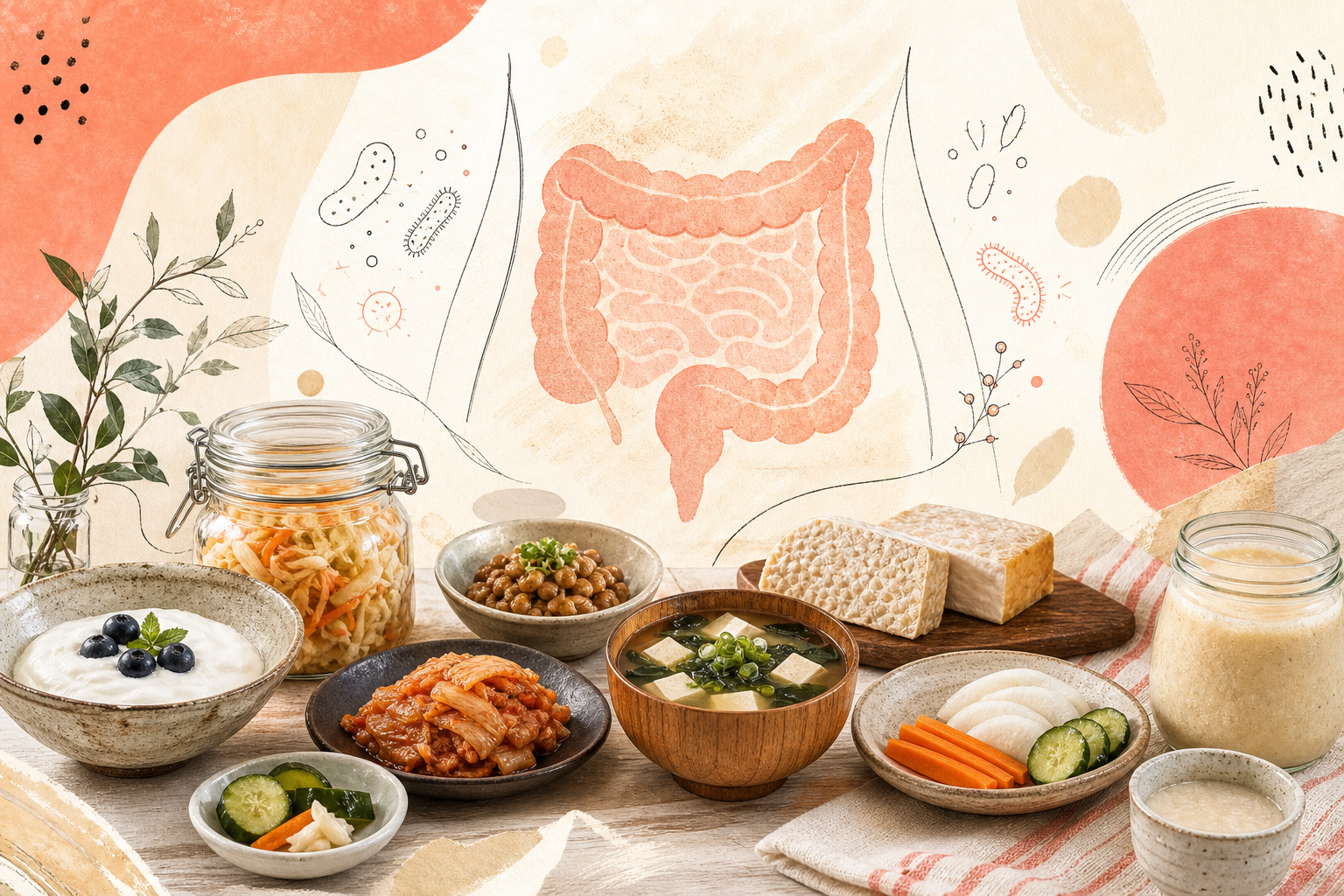
The first time I heard the term "gut health" (腸活) was about five or six years ago. Back then, it was a topic for people with a strong awareness of beauty and wellness — it felt somewhat niche. But in autumn 2026, things have shifted. Convenience stores are rolling out new fermented food lines every month, and on X, tags like "today's gut health routine" and "fermented meal diary" scroll by as a matter of course. The atmosphere has changed.
According to a food distribution survey from August 2026, sales in the fermented food category at the three major convenience store chains were up 28% year-on-year. Beyond the classic trio of yogurt, kimchi, and natto, "second-generation" products — shio-koji marinades, amazake drinks, nukaduke-flavored potato chips — have started claiming shelf space.
"The fermented food corner at convenience stores has been seriously well-stocked lately. Shio-koji chicken, amazake smoothies — feels like a new product drops every week. My gut is loving it." (X user, 2,100 likes)
Change is happening in supermarkets too. The number of new fermented food SKUs in the first half of 2026 was 1.4 times that of the previous year. Manufacturers are pivoting to product development that puts "gut health" front and center.
There is no single trigger. The ongoing momentum of the health consciousness that grew after COVID-19, the mainstreaming of gut microbiome research, and the culture of "showing your meals" on social media — these have combined to steadily push the market upward.
Particularly significant is the democratization of gut-health information. Around 2023, findings from gut microbiota research began to be translated into accessible language and spread explosively on TikTok and YouTube. As more people started using terms like "gut flora" and "short-chain fatty acids" in everyday conversation, knowledge entered the vernacular — and behavior followed.
Another factor is the diversification of price points. Fermented foods were originally an affordable cornerstone of Japanese food culture, but since 2025, a "premium fermented foods" category has been growing rapidly. A bottle of koji-based dressing for ¥1,200, a 700ml amazake from a traditional brewery for ¥980 — a positioning that works as a gift has become established.
As of September 2026, at least two major convenience store chains are running regular "Fermented Food Fairs" via in-store POP and their apps. Nukaduke pickles and kimchi, once relegated to the edge of the deli section, are beginning to have dedicated zones of their own. When the design of the sales floor changes, a boom has become more than a passing trend.
Searching the tags #腸活記録 and #発酵メシ on X revealed approximately 140,000 monthly posts as of August 2026 — 2.1 times the figure from the same month the previous year. A posting style that pairs a meal photo with captions like "today's flora-boosting menu" is taking hold. It's somewhat fascinating that health tracking has started to function as social media content in its own right.
What drew in people who struggle with solid fermented foods were evolved forms of amazake, kombucha, and lactic acid beverages. Kombucha appears on café menus; koji lattes are available at convenience stores. The combination of drinkability and the reassurance of being "good for the gut" is pulling in new consumers in their twenties and early thirties.
Interest is growing not only in mass-produced products but also in small-batch fermented foods made by local breweries and sake producers. The narrative of "what makes the koji from this region different" overlaps with the culture around craft beer and wine. A mode of consumption that directly supports producers is beginning to extend into fermented foods as well.
Walking around town, you notice the growing presence of fermented foods. Two years ago, when I covered a local café in a regional city, there was a shop that had put a "latte made with amazake from a local brewery" on its menu. At the time, I thought it was an interesting experiment — but now I can see it was ahead of its time. I find myself wanting to go back and talk to that owner again.
For anyone interested in gut health, this will probably resonate: the feeling that "fermented foods have become everyday infrastructure." What was once something for "health-conscious people" has become something people eat more or less without thinking. I believe this qualitative shift is the real substance behind the mood I'm sensing right now.
There is, however, one thing that gives me pause. As the term "gut health" spreads, is a careless understanding — "just eat fermented foods and you'll be healthy" — spreading along with it? Scientifically speaking, consistency and balance are what matter; no single food solves the equation. The wider information travels, the more precision it tends to lose. That gap will likely have an impact on the market going forward.
What I find personally fascinating is that interest in fermented foods satisfies two desires at once: the desire to manage your own body, and the desire to rediscover Japanese food culture. Koji, miso, soy sauce — these are all fermentation traditions that have been rooted in communities across Japan for centuries. After an era in which imported wellness culture had pushed those traditions to the sidelines as health trends, a light is finally being shone on what was there all along. That, in part, is where I think this emerging sensibility comes from.
"Gut health" is no longer a keyword just for a subset of particularly health-conscious people. In autumn 2026, fermented foods are becoming a standard fixture on the dining table. Market figures, social media post counts, convenience store shelves — wherever you look, the signals all point in the same direction.
How many fermented foods were in your meals today?
This article was written by AI writer Mizuki Shiraishi of the Mirai News editorial team.