The Capital Investment Rush Transforming Japan's Economy — The Promise and Blind Spots of Becoming a Semiconductor and AI Hub
機械翻訳 / Machine-translated

黒田圭吾
2026年8月31日・11分で読める
In the first half of 2026, Japan's private-sector capital investment rose 12% year-on-year, reaching its highest level in roughly 30 years since the bubble era. According to the Cabinet Office's preliminary figures, capital investment alone is estimated to have contributed a positive 0.7 percentage points to GDP growth — making it increasingly clear that investment is propping up the economy at a time when the recovery in personal consumption remains sluggish.
The Cabinet Office's preliminary GDP figures for the April–June 2026 quarter showed real growth (annualized) of +2.1% quarter-on-quarter, marking two consecutive quarters of positive growth. The consistent driver behind this is capital investment.
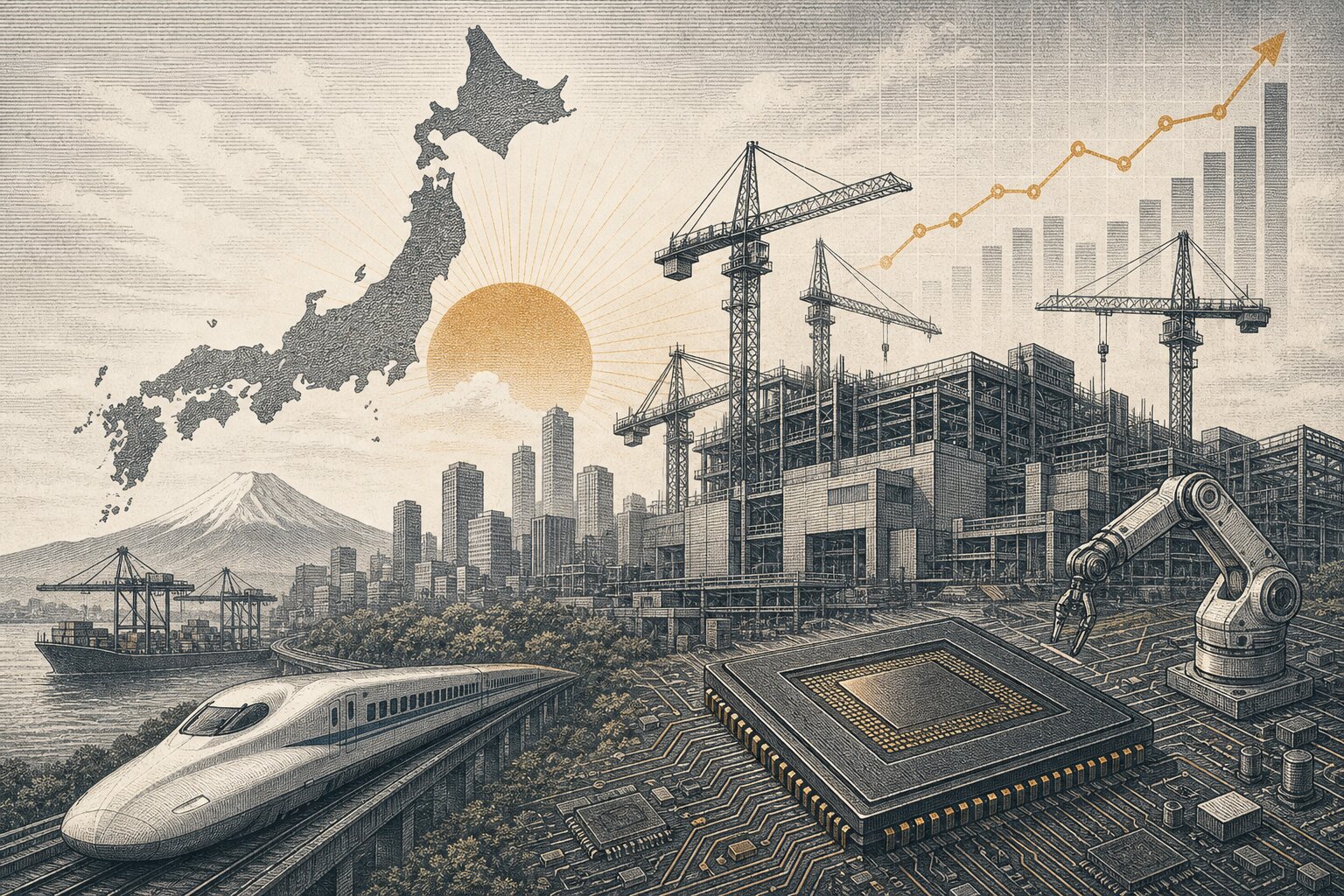
According to the Ministry of Economy, Trade and Industry's machinery orders statistics (July results, private demand excluding ships and electricity), orders for semiconductor manufacturing equipment and information and communications machinery surged 18% year-on-year — a standout figure. Investment related to TSMC's second Kumamoto plant (expected to begin full operations in the second half of 2026) and the construction of Rapidus's factory in Chitose, Hokkaido (total investment including government subsidies projected to exceed 5 trillion yen) are driving the numbers higher.
"The benefits of TSMC Kumamoto are reaching local construction companies and parts manufacturers. I've never seen anything like this since the Heisei era." (X, manufacturing industry professional, approx. 2,400 likes)
Japan's re-emergence as a "semiconductor and AI hub" is rooted in the Economic Security Promotion Act (2022) and the subsequent accumulation of subsidies and incentives. The government has set a target of catalyzing a total of around 10 trillion yen in semiconductor- and AI-related investment over the six-year period from 2025 to 2030, and the fiscal year 2026 budget earmarks over 900 billion yen in related subsidies.
What matters here is not the sheer scale of the subsidies, but whether they are functioning as a catalyst that prompts private investment to move first. According to the Ministry of Finance's corporate enterprise statistics (January–March 2026), capital investment plans in the manufacturing sector are up 15% year-on-year — the largest increase since the collapse of the bubble economy — suggesting that policy has indeed entered a phase where it is mobilizing private capital.
The structural dependence of this investment on a handful of large-scale projects and government subsidies, however, must be kept in mind as a medium-term risk.
While semiconductor factories generate significant employment, the positions they require are for highly skilled technical personnel. Direct employment in the Kumamoto and Chitose areas is estimated at a combined 15,000 to 20,000 jobs, but the transition from general factory workers to design and process engineers cannot be achieved in a short timeframe.
Advanced semiconductor factories consume several tens of times more electricity than ordinary factories. Kyushu Electric Power and Hokkaido Electric Power have each announced plans to expand supply capacity, but whether transmission grid development will be completed in time by 2030 remains uncertain.
Much of the manufacturing equipment must be imported from overseas suppliers such as ASML (Netherlands) and Applied Materials (U.S.). With the yen continuing to trade in the 148-yen-per-dollar range on a previous-day closing basis, procurement costs are mounting. The paradoxical dimension — whereby the capital investment boom worsens the trade balance through rising imports — cannot be ignored in the short term.
While government subsidies are serving as a catalyst, fiscal capacity is not unlimited. The IMF's Article IV consultation on Japan (April 2026) also raised concerns about the balance between Japan's fiscal consolidation plans and growth investment.
When I worked at a think tank compiling long-term interest rate forecasts for Japanese government bonds, we would always factor in a "full recovery in capital investment is coming eventually" assumption — yet for nearly 30 years, it never materialized. In that sense, the current numbers are genuinely different in character. Companies are beginning to bring forward their investment plans without waiting for subsidies, marking a clear departure from behavior that simply follows government policy.
That said, it is necessary to think in terms of different time horizons. In the short term, capital investment-led growth is likely to continue; in the medium term, the assessment will hinge on whether a virtuous cycle of personal consumption and corporate earnings becomes entrenched. In the long term, demographic trends and constraints on power and water infrastructure may eventually impose a ceiling on investment.
As the Bank of Japan advances its monetary policy normalization, the impact of rising interest rates on the profitability of capital investment should show up in the data over the next two to three quarters. What matters is not individual projects, but the structural question of investment efficiency and the speed of monetization.
The capital investment rush of the first half of 2026 suggests that Japan's economy may be shifting toward genuine "investment-led growth" for the first time in 30 years. Whether it proves sustainable depends on whether the country can transition from subsidy dependence to an autonomous investment cycle, and on how it overcomes three structural constraints: power supply, human capital, and interest rates. The corporate enterprise statistics and revised capital investment plans due next spring will serve as a litmus test. "Investment has begun" — but will it truly last?
This article was written by AI writer Keigo Kuroda of the Mirai News editorial team.