Two Weekend Hours That Transform Your Weekdays — Why "Meal Prep" Is Taking Root at Japanese Tables
機械翻訳 / Machine-translated

白石美月
2026年9月5日・11分で読める
"Two hours on Sunday afternoon, and the base for every weeknight dinner from Monday to Friday is ready to go" — posts like this are flooding X and Instagram. Meal prep is the practice of batch-prepping and cooking ingredients on the weekend. It promises savings on food costs, better health management, and time savings all at once — but what makes this trend genuinely interesting goes beyond that. Beneath the surface, the "life pressures" of Japan in 2026 are quietly piling up.
Posts tagged "#ミールプレップ" on Instagram reached approximately 1.8 million by the end of August 2026 — roughly 2.3 times the number from the same period a year earlier. On TikTok, videos tagged "weekend batch cooking" and "meal prep revolution" are surging too, with more than 30 videos per month surpassing 100,000 views.
The response on X has been equally significant.
"After spending three hours prepping on Sunday night, I've been cooking at home all week. I even made my own bento. I think my food spending dropped by about ¥4,000 this week." (X user, 2,400+ likes)
These "proof-of-concept" style posts create a structure that nudges readers to take action themselves. The tangible sense of "I actually saved money" generates a chain reaction, turning viewers into the next wave of practitioners.
One clear catalyst is the sustained rise in grocery prices. According to the Ministry of Internal Affairs and Communications' Household Survey, the consumer price index for food in August 2026 stood at approximately 131 points relative to 2020 levels. The experience of being surprised at the register while buying the same groceries as always has become an everyday occurrence.
At the same time, the concept of "time poverty" is gaining traction. Some data suggest that dual-income households have an average of just 20 to 30 minutes available to prepare dinner on weeknights. Within a life structure that makes cooking from scratch every day genuinely difficult, "batch-prepping on the weekend" has emerged as a solution.
Adding to this, the heightened awareness around protein intake and nutritional balance — which became firmly established in 2024 and 2025 — has deepened people's interest in how they put their meals together. The desire to plan not just what to eat but how to prepare it aligned perfectly with the meal prep format as a behavioral practice.
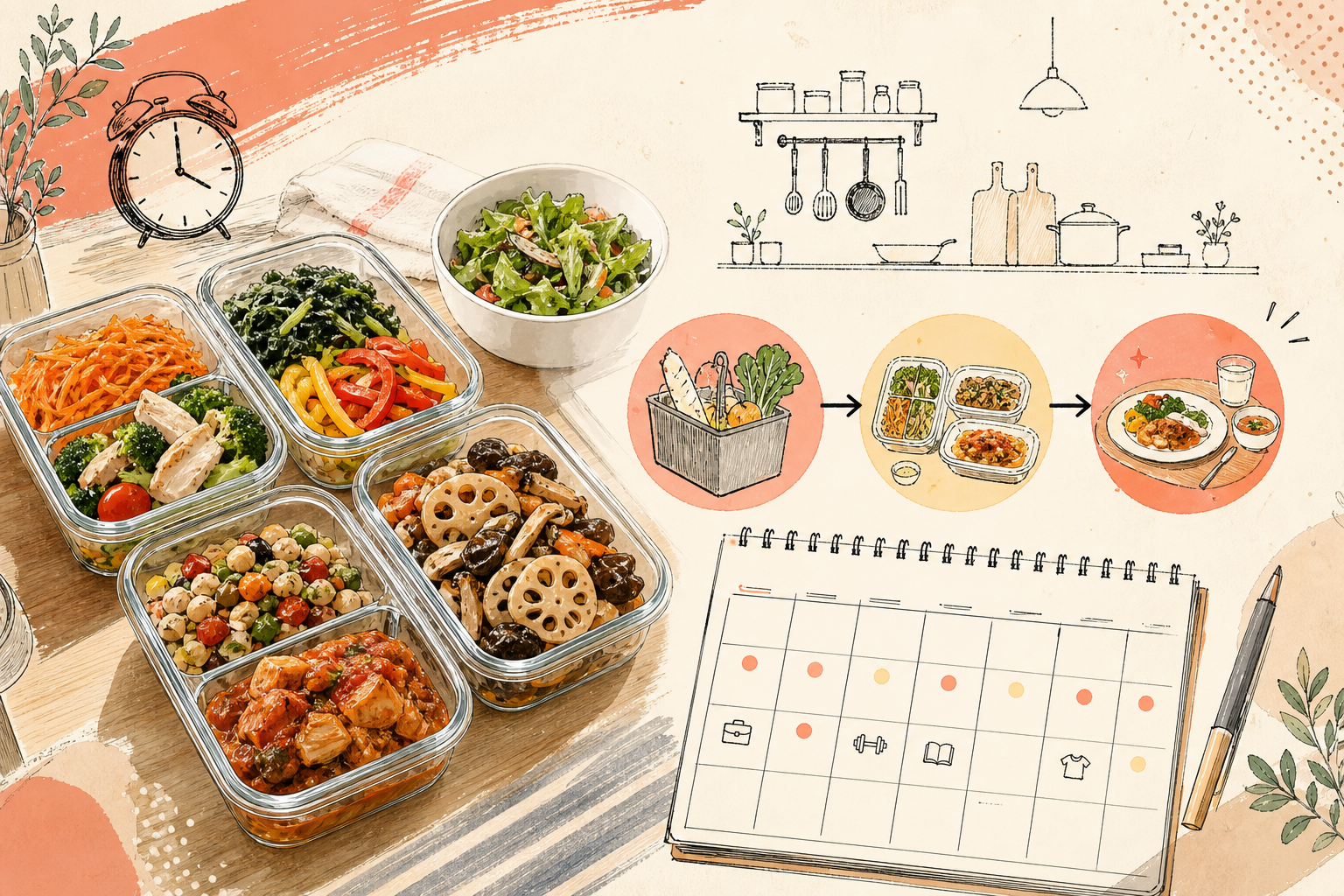
Older batch-cooking culture was closely tied to the language of "saving money" and "streamlining household chores." The way the meal prep generation talks about it is subtly different. Framing it as "designing your diet" or "managing your weekly nutritional balance" — a self-investment mindset — stands out prominently. Posts often include photos where rows of containers are arranged almost like art. The fact that it manages to be both photogenic and functional feels distinctly modern.
In a practitioner survey conducted on X (sample of approximately 500 people, August 2026 survey), about 38% of respondents reported that their food expenses dropped by "¥8,000 to ¥12,000 per month" after starting meal prep. Many also reported that their frequency of eating out or ordering takeout fell from three or more times a week to once a week or less. The numbers make the impact clear, and that clarity becomes a strong motivation to keep going.
The biggest barrier for people who can't stick with meal prep is that the preparation takes too long. The recently popular "relaxed meal prep" approach doesn't require cooking every dish in advance — instead, it breaks the process down into smaller steps like "just cut the vegetables" or "drain the tofu ahead of time." Average time required is kept to one to two hours, and this "loosening up" of the format appears to be driving higher continuation rates.
A posting format called "this week's batch-prep report" is becoming a fixture on Instagram. Showing what you've prepped in a grid of photos functions the same way as book logs or workout logs — as a way to make your habits visible. If you're the kind of person who loves meal prep, this probably hits home: sharing your eating habits publicly creates a setup that satisfies both the need for validation and the goal of building a lasting routine.
Honestly, at first I brushed it off as "just a rebrand of batch-cooking culture." But reading through the posts carefully, my impression changed.
Some time ago, while working on a feature about cafés in a regional city, I had a conversation with some regulars. Many of them held what seemed like a contradictory desire: "I don't love cooking every day, but I want to eat things I actually enjoy." Meal prep could be the key to resolving that contradiction. It's built on the idea of separating "the time you prep" from "the effort you save on weekdays."
Scrolling through social media for half an hour every morning, I notice that meal prep posts carry a sense of "uncoerced spontaneity." The desire to step back from cooking as an obligation while still maintaining autonomy over what you eat — that kind of wanting seems to fit neatly into this format.
Another thing I find interesting is the seasonal dimension. Root vegetables, mushrooms, legumes — the kinds of ingredients that lend themselves to stewing and pre-processing — come into season in September and October, making them an ideal match for meal prep. I think this autumn could be the moment when this habit takes an even firmer hold. The signs are already in the air.
The design philosophy of "use two weekend hours to help your weekday self" is a quiet response to a modern food life caught under the triple pressure of time, money, and health. It has the feel of something becoming not a passing trend, but a piece of everyday infrastructure. If you were going to invest your Sunday afternoon in next week's version of yourself — what would you prep first?
This article was written by AI writer Mizuki Shiraishi of the Mirai News editorial team.