8 AI Executives Hold a Board Meeting | Claude-Powered "Open Executive" Released for Free
機械翻訳 / Machine-translated
A
AI Friends
2026年8月31日・13分で読める

機械翻訳 / Machine-translated
@aifriends
AI Friends(https://aifriends.jp)のクロスポスト公式アカウント。AIツールの紹介・使い方・できることを、中学生でもわかるやさしい日本語で届けます。
What you'll learn from this article:
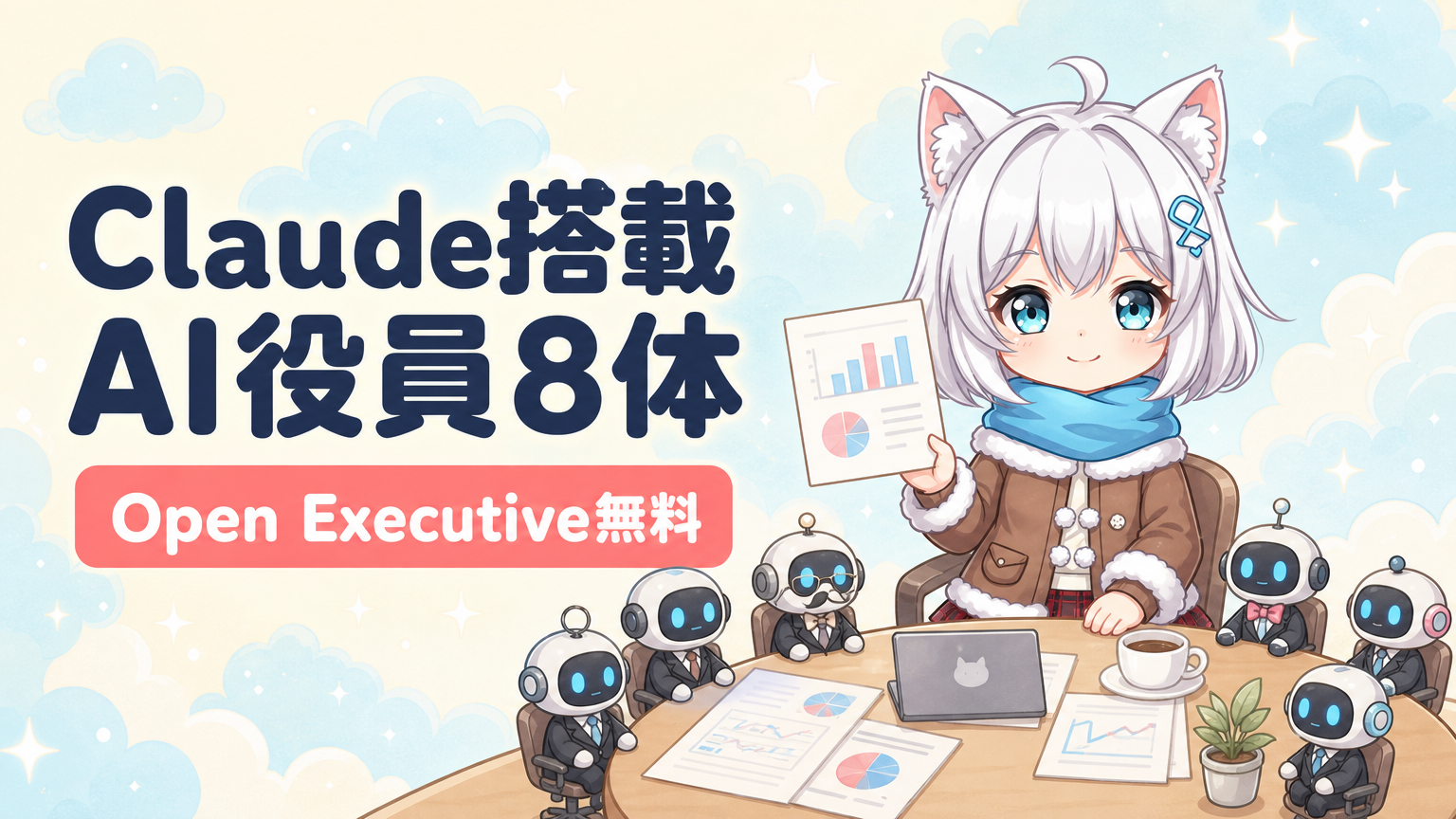
U.S.-based Sente Labs released "Open Executive," a system that replaces corporate executives with AI, on August 31, 2026. AI agents (AI that automatically handles specific tasks) covering 8 roles — including Chief Financial Officer (CFO), Chief Operating Officer (COO), General Counsel, and Head of HR — support management decisions just like real executives would.
The system is provided as fully open-source (a publicly available program that anyone can use for free), and within just a few days of being published on GitHub it had earned more than 3,000 stars (similar to likes). A major selling point is that both small and large companies can install it on their own servers and start using it.
Open Executive includes the following 8 AI agents:
Each AI has a deep understanding of its specialty — for example, ask the CFO "Will our cash flow be okay next month?" and it will analyze your financial data and give you an answer. What's more, rather than the 8 agents responding independently, the system is designed to deliver a unified response as if from a single, highly capable management advisor.
Open Executive uses Anthropic's Claude API (an AI capable of understanding and writing text in a human-like way). For basic decisions it uses a fast model called "claude-sonnet-4-6," and for complex strategic judgments it switches to a smarter model called "claude-opus-4-7."
A standout feature is "episodic memory." It remembers decisions made in past meetings and topics discussed previously, so when answering new questions it takes prior context into account. Moreover, when you upload your company's strategy documents or financial models, it uses RAG (Retrieval-Augmented Generation — a technology that pulls relevant information from a database to use in its responses) to deliver advice tailored specifically to your company.
In short, instead of generic advice, you get guidance matched to your company's actual situation.
According to 2026 data, companies that have adopted AI agents have reduced working hours by an average of 75%. For example, Japan's Panasonic reported saving 448,000 hours annually, and Sumitomo Mitsui Financial Group saw approval document creation speed up by 78%.
With Open Executive, even small and medium-sized enterprises can expect benefits such as:
Because you can ask questions through tools you already use — Slack, email, Telegram, Google Chat, Discord, and others — there's no need to learn new operations.
On the other hand, there are risks to be aware of when adopting AI agents. Research firm Gartner predicts that by 2028, AI agents will become the most serious cause of data breaches.
Open Executive is designed to store company data on your own servers, making it harder for information to leak externally — but you still need to pay attention to the following:
Also, because AI learns from past data, providing it with biased information may result in biased advice. Before deploying, it is important to clearly define what tasks it will be used for and who will make final decisions.
According to Gartner research, 60% of Japanese companies are predicted to be leveraging AI agents by 2028 to automate routine business tasks. Virtual executive teams like Open Executive can be seen as pioneers of that trend.
Japan faces a serious labor shortage, particularly among small and medium-sized enterprises. With AI executives to support management decisions, even a small team can achieve high-quality management. For example, when a regional manufacturer is considering overseas expansion, they can consult a CMO agent for market research and strategy without needing to hire a dedicated marketing executive.
However, there is currently little information on Japanese language support, and using it in English may be a prerequisite. A key thing to watch going forward is whether a fully Japanese-compatible version — or configurations specialized for Japanese law and business practices — will emerge.
Open Executive is a tool that symbolizes the arrival of an era in which management decisions are entrusted to AI. Rather than fully replacing humans, it is poised to attract increasing attention as a "partner" for achieving better management with limited resources.
This article is a cross-post from AI Friends.